I've come to believe that life isn't defined by where you start, how much you accomplish, or even how many times you get knocked down. It's defined by what you choose to do next.
Over the years, I've experienced the satisfaction of building successful businesses, the challenges of navigating unfamiliar territory, and the reality that life rarely unfolds according to plan. I've learned that success is never permanent, failure doesn't have to be final, and the ability to change direction can be just as valuable as the determination to stay the course.
Through it all, three words have come to represent the way I approach both business and life.
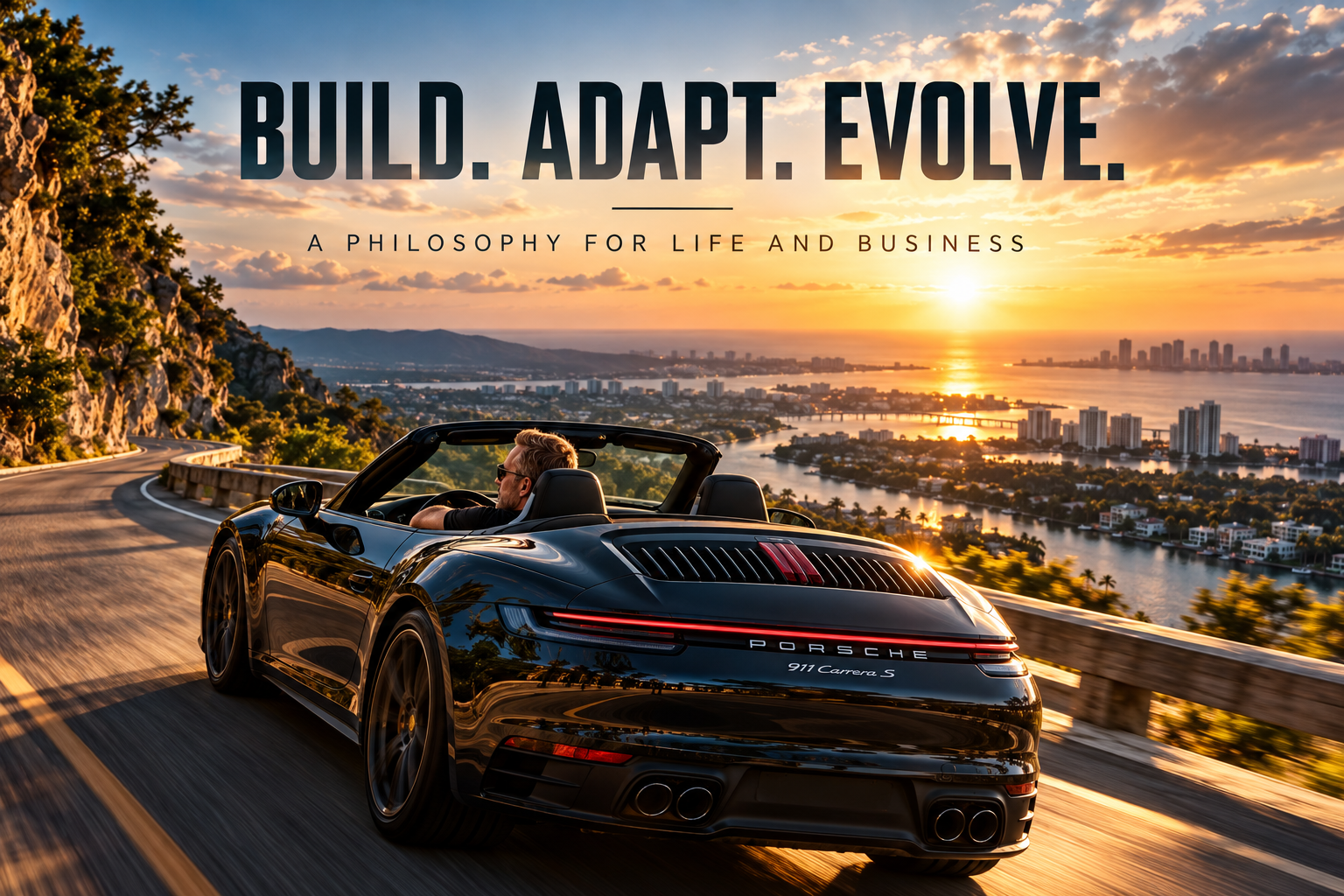
Build. Adapt. Evolve.
They're more than a catchy phrase. They're principles that have shaped my decisions, influenced my perspective, and helped me move forward through different chapters of my life.
BUILD. Nothing Happens Until You Take Initiative.
When I was 18 years old, I enlisted in the United States Navy. Like most young men at that age, I had more ambition than experience and very little understanding of where life would eventually take me.
What the Navy gave me was something far more valuable than a roadmap. It taught me discipline, accountability, leadership, and the importance of taking responsibility for the things within my control.
Those lessons stayed with me long after my military service ended.
As I moved into the business world, I discovered that entrepreneurship rewards many of those same qualities. You have to be willing to make decisions without having all the answers. You have to accept responsibility when things go wrong. And perhaps most importantly, you have to be willing to act while other people are still contemplating what might happen.
I've founded companies, developed products, built teams, and pursued opportunities in industries ranging from technology to international business. Some ventures became successful enterprises. Others taught me lessons that no business school could have provided.
But every one of those experiences began with the same decision: to build something rather than wait for someone else to create the opportunity.
Building isn't just about starting a company or generating revenue. It's about creating something meaningful. It might be a business, a relationship, a new skill, or a better version of yourself.
I've always believed that opportunities are more often created than discovered. The people who accomplish extraordinary things aren't necessarily the ones with the greatest advantages. They're often the ones willing to take initiative, accept calculated risks, and do the work.
You don't need to know exactly how the story ends before you begin writing it.
You just have to begin.
ADAPT. The World Doesn't Owe You Predictability.
If building requires initiative, adapting requires something equally important: humility.
Life has a way of reminding us that we're not always in control.
Markets change. Technologies evolve. Relationships shift. Businesses encounter unexpected challenges. Sometimes circumstances change so dramatically that the plans you spent years developing are no longer relevant.
I've experienced enough unexpected turns in my own life to understand that resisting change rarely makes it disappear.
There have been times when I've had to reassess everything I thought I knew about where I was headed. Times when the next chapter looked nothing like the one I had envisioned.
Those experiences taught me an important distinction: there's a difference between giving up on your goals and recognizing that the path toward them needs to change.
Adaptability isn't weakness. It's intelligence applied to changing circumstances.
In business, I've watched entire industries transform because of technological innovation, economic shifts, and changing customer expectations. Companies that once seemed untouchable disappeared because they couldn't adapt. Meanwhile, smaller, more agile competitors recognized new opportunities and moved quickly.
The same principle applies to our personal lives.
We can't always control what happens to us. But we have considerable influence over how we respond, what we learn, and what we decide to do next.
I've also learned that adapting doesn't mean compromising your values. In fact, knowing which principles you're unwilling to compromise makes it easier to remain flexible about everything else.
You can change your strategy without abandoning your purpose.
Sometimes the smartest thing you can do is acknowledge that yesterday's approach isn't going to solve tomorrow's problem.
And then have the courage to try something different.
EVOLVE. Never Become a Finished Product.
Of the three principles, evolve may be the most important.
Building gets you started. Adapting keeps you moving. But evolving ensures that you're continuing to become something more than you were yesterday.
I don't believe personal growth has an expiration date.
One of the things that excites me most about this stage of my life is the extraordinary pace of technological change. Artificial intelligence, automation, and emerging digital capabilities are creating opportunities that would have seemed unimaginable just a few years ago.
Rather than viewing these developments as threats, I see them as invitations to learn.
Today, I spend considerable time exploring emerging technologies, developing new business capabilities, and challenging assumptions about how work should be accomplished.
I'm still curious. I'm still learning. And I'm still building.
But evolution isn't exclusively about business or technology.
It's also about perspective.
As I've gotten older, I've developed a greater appreciation for the importance of relationships, health, family, personal freedom, and peace of mind.
I've come to recognize that financial success, while important, is only one measure of a meaningful life. The freedom to spend time with people you care about, pursue experiences that inspire you, and wake up with a sense of purpose matters just as much.
I've also become more comfortable acknowledging that I don't have all the answers.
There's something liberating about reaching a point in life where you no longer feel compelled to prove yourself to everyone else.
You can focus instead on becoming the person you genuinely want to be.
Evolution requires curiosity, self-awareness, and the willingness to reconsider beliefs that may have served you well in the past but no longer reflect who you're becoming.
It also requires recognizing that success isn't a destination you eventually reach.
It's a process of continuous improvement.
The Road Ahead
When I look back over the different chapters of my life, I don't see a perfectly straight line connecting one accomplishment to the next.
I see decisions, opportunities, mistakes, lessons, unexpected detours, and moments when I had to figure out what came next.
And I wouldn't trade the perspective those experiences have given me.
I still have ambitions. There are businesses I want to grow, places I want to visit, people I want to meet, and experiences I want to share with those closest to me.
But I'm no longer measuring progress exclusively by how quickly I reach the next milestone.
I'm increasingly interested in the quality of the journey itself.
There's a certain freedom that comes from understanding that your past doesn't have to dictate your future, your circumstances don't have to define your potential, and you're never too old or too established to begin something new.
That's what Build. Adapt. Evolve. means to me.
Build something worth pursuing.
Adapt when life demands a different approach.
Evolve into someone capable of recognizing and embracing the opportunities ahead.
And above all, never stop moving forward.
— Dan Lounsbury