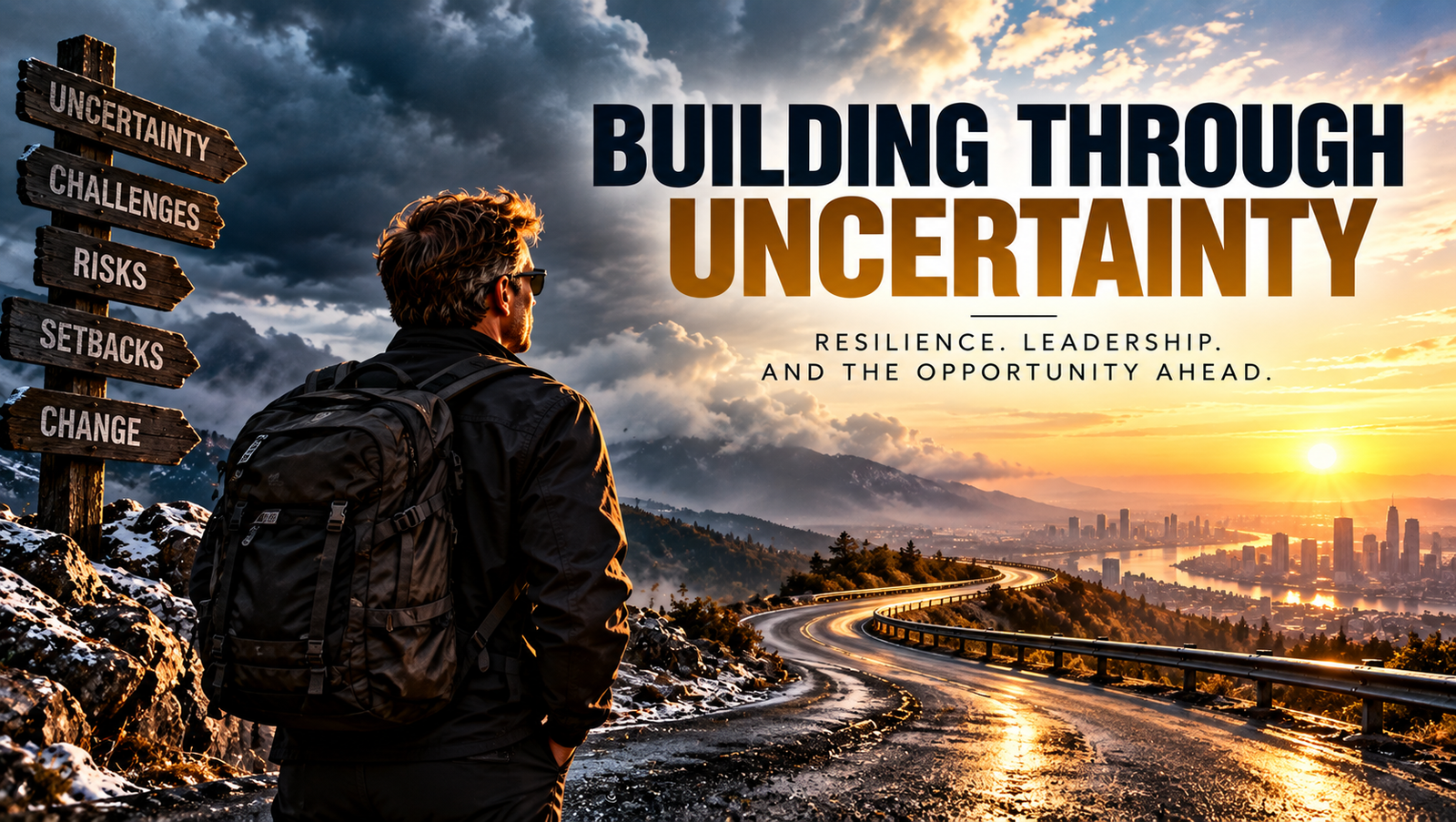
If there's one thing I've learned throughout my life, it's that things rarely go exactly according to plan. You can spend years building a business, developing relationships, and creating what you believe is a clear path toward the future, only to discover that circumstances can change almost overnight. Markets shift, opportunities disappear, people disappoint you, and sometimes life presents challenges that you never could have anticipated.
I've experienced my share of those moments, both personally and professionally. I've built companies from the ground up, worked in challenging international environments, managed large organizations, and experienced the satisfaction of seeing years of hard work turn into something successful. I've also faced setbacks that forced me to reconsider everything I thought I knew about business, leadership, and the direction of my life.
What I've come to understand is that uncertainty isn't something we can eliminate. It's something we have to learn to navigate. And in many cases, the experiences that initially appear to be our greatest setbacks eventually become the very things that prepare us for our next opportunity.
The Illusion of Having Everything Under Control
Entrepreneurs are naturally optimistic people. We identify opportunities, calculate risks, and convince ourselves that with enough determination and hard work, we can accomplish almost anything. That confidence is necessary because building a business requires an enormous amount of faith in your own judgment, particularly when other people don't necessarily see the same opportunities you do.
But confidence and control are two very different things.
During my years building Tactical Products Group, I learned how quickly the business environment could change. We were operating in demanding markets, serving major government contractors, managing manufacturing relationships, and dealing with complex international supply chains. Decisions often had to be made with incomplete information, and the consequences of getting those decisions wrong could be significant.
The experience taught me that leadership isn't about having all the answers. It's about developing the judgment to make difficult decisions, accepting responsibility for the outcome, and being willing to adjust your approach when circumstances demand it.
Some of the most important decisions I've made in business weren't necessarily the ones that looked brilliant at the time. They were the ones that allowed us to remain flexible, preserve relationships, and position ourselves to take advantage of opportunities that hadn't even existed when we made the original decision.
Resilience Is Something You Develop
People often talk about resilience as though it's a personality trait that some individuals naturally possess and others don't. My experience has been different. I believe resilience is developed through experience, particularly through situations that test your confidence, patience, and ability to keep moving forward.
It's relatively easy to remain positive when business is good, your relationships are strong, and everything seems to be moving in the right direction. The real test comes when those conditions change and you're forced to confront circumstances that are uncomfortable, unfamiliar, or completely outside your control.
I've had periods in my life when the future was anything but certain. There were times when I had to reassess my priorities, reconsider relationships, and make difficult decisions about what I wanted the next chapter of my life to look like. Those experiences weren't always pleasant, and I certainly wouldn't pretend that every setback immediately revealed some wonderful hidden opportunity.
Sometimes adversity is simply adversity, and getting through it requires patience, discipline, and a willingness to accept that rebuilding takes time.
But I've also discovered that difficult circumstances have a way of stripping away distractions. They force you to identify what's genuinely important, recognize the things you can influence, and stop wasting energy on things you cannot change.
Over time, that perspective becomes an advantage. You become less intimidated by uncertainty because you've experienced it before, and you've learned that your ability to respond matters far more than your ability to predict every possible outcome.
Reinvention Is Not the Same as Starting Over
One of the most interesting aspects of my career is how different my businesses have been from one another. My early experience in telecommunications and China led to opportunities in manufacturing and government contracting. Those experiences eventually contributed to my work in private intelligence, technology, and digital asset recovery.
On the surface, those industries may seem unrelated. But I've never viewed those transitions as abandoning one career to begin another. I've always seen them as building upon the experience, relationships, and knowledge I accumulated along the way.
When I founded Soturis, I brought with me decades of experience in international business, complex negotiations, risk management, and understanding how people and organizations operate. The technology has evolved dramatically, and the tools available today are far more sophisticated than anything I could have imagined earlier in my career. But the underlying principles of identifying opportunities, understanding risk, and solving difficult problems remain remarkably consistent.
The same applies to BlockDivers, where our work focuses on tracing digital assets and helping victims pursue financial recovery. It's a different environment with different challenges, but it still requires persistence, analytical thinking, and the ability to work through situations where the answers aren't immediately apparent.
I think too many people hesitate to reinvent themselves because they believe doing so means walking away from everything they've already accomplished. In my experience, the opposite is often true. Your previous successes and failures become the foundation for whatever you choose to build next.
The key is remaining curious enough to recognize when it's time to evolve.
Leadership When the Path Isn't Clear
One of the responsibilities that comes with leadership is recognizing that other people are looking to you for direction, particularly during difficult periods. Employees, business partners, and clients want to know that someone is thinking ahead and making decisions with their interests in mind.
That doesn't mean pretending to have certainty when none exists. I've always respected leaders who can acknowledge a challenge, explain their thinking, and communicate a realistic plan more than those who insist everything is fine when the evidence suggests otherwise.
Good leadership requires a balance between confidence and humility. You need enough confidence to make decisions and move forward, but enough humility to recognize when new information requires you to change course.
It also requires emotional discipline. When circumstances become difficult, people pay attention to how a leader responds. If you're constantly reacting emotionally, blaming others, or allowing frustration to dictate your decisions, that behavior eventually affects everyone around you.
I've learned that maintaining a sense of equanimity, particularly under pressure, is one of the most valuable qualities a leader can develop. It doesn't mean you stop caring about the outcome or become indifferent to the challenges you're facing. It means you learn to approach those challenges with perspective rather than allowing them to control your thinking.
And sometimes, the most productive thing you can do is acknowledge that you don't yet have the answer, gather more information, and give yourself the time necessary to make a better decision.
Finding Opportunity in an Uncertain World
We're living through a period of extraordinary technological and economic change. Artificial intelligence is transforming entire industries, geopolitical relationships are shifting, and the speed at which information moves has fundamentally altered how businesses compete.
For some people, that level of uncertainty is intimidating. They see disruption primarily as a threat to the systems and opportunities they've become comfortable with.
I tend to look at it differently.
Throughout my career, some of the most interesting opportunities have emerged during periods of significant change. New technologies create new markets, changing economic conditions expose unmet needs, and industries that once seemed firmly established suddenly become vulnerable to entirely different ways of doing business.
That doesn't mean every new technology or emerging trend represents a worthwhile opportunity. Experience has taught me to be skeptical of hype and to distinguish between something that merely attracts attention and something that creates genuine, sustainable value.
But I believe the willingness to explore unfamiliar territory is essential, especially as we get older and become more established in our ways of thinking.
I'm as interested in learning and building today as I was when I first started my entrepreneurial journey. In some respects, I'm even more enthusiastic because I now have the benefit of experience to help me recognize opportunities that I might have overlooked twenty years ago.
The Next Chapter Is Always Being Written
When I reflect on the different chapters of my life, I don't measure them exclusively by financial success, professional accomplishments, or the businesses I've built. Those things matter, and I'm proud of what I've accomplished, but they don't tell the entire story.
I'm equally interested in what those experiences taught me, the relationships I've developed, the challenges I've overcome, and the person I've become along the way.
I also recognize that success means different things at different stages of life. There was a time when growing a company, increasing revenue, and achieving financial independence occupied most of my attention. Those remain important considerations, but today I'm also focused on maintaining balance, enjoying meaningful experiences, being present for the people who matter to me, and pursuing work that genuinely interests me.
Perhaps most importantly, I've stopped believing that there is some final destination where everything will suddenly become predictable and perfectly organized. Life doesn't work that way, and neither does business.
There will always be unexpected challenges, changing circumstances, and decisions that require us to move forward without knowing exactly how everything will turn out.
What matters is developing the confidence to navigate those moments without allowing them to define or discourage you.
That's really what my personal philosophy of Build. Adapt. Evolve. represents. Building requires initiative and the willingness to take risks. Adapting requires humility, flexibility, and the ability to recognize when circumstances have changed. Evolving means taking everything you've learned, both good and bad, and using it to become better prepared for whatever comes next.
I don't know exactly what the next ten years will look like, and I'm perfectly comfortable with that. What I do know is that I intend to keep learning, exploring new opportunities, building meaningful relationships, and challenging myself to accomplish things I haven't done before.
Because I've come to believe that uncertainty isn't necessarily an obstacle standing between us and the future we want to create.
Sometimes, it's simply where the next opportunity begins.
Dan Lounsbury
Entrepreneur | Navy Veteran | Founder