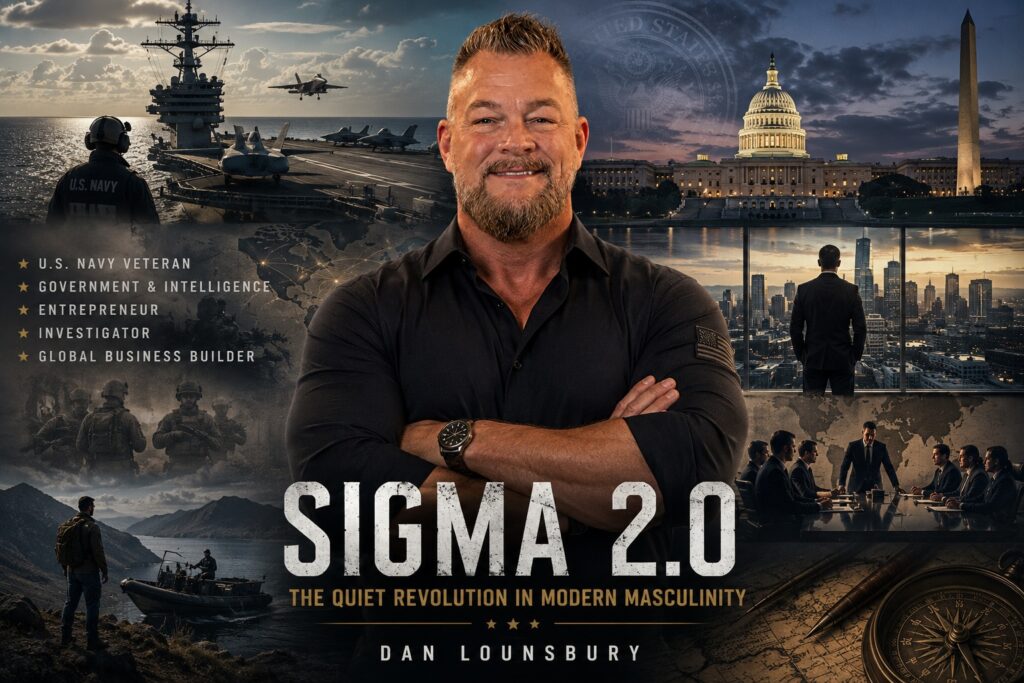
If you met me for the first time, you would probably make a few assumptions before we ever shook hands. I’m a large, physically imposing guy. I’m a Navy veteran. I’ve spent years in government, intelligence, private investigations, and security. I’ve built businesses in industries where confidence, decisiveness, and resilience aren’t optional—they’re prerequisites. From the outside, it’s easy to assume you already know my story. Most people expect someone who subscribes to the traditional definition of masculinity: competitive, emotionally reserved, relentlessly driven, and always prepared to prove he’s the strongest person in the room.
What usually surprises people is that the older I’ve become, the less interested I am in proving any of those things. In fact, I’ve come to believe that many of the qualities we traditionally associate with strength are only part of the equation. Physical discipline matters. Courage matters. The willingness to protect the people you love absolutely matters. But without emotional intelligence, self-awareness, humility, and the ability to understand both yourself and others, those qualities remain incomplete. Some of the strongest men I’ve ever met possessed an extraordinary level of quiet confidence, and that confidence didn’t come from intimidating other people. It came from knowing exactly who they were, regardless of whether anyone else recognized it.
For much of my life, I probably fit what society would call an alpha male. I enjoyed competition. I thrived on building businesses, solving difficult problems, and setting ambitious goals. I measured success the way many people do—by growth, achievement, financial independence, and the ability to overcome adversity. There is nothing inherently wrong with those pursuits, and I still believe discipline and ambition are essential virtues. But life has a way of teaching lessons that no business school, military training program, or leadership seminar ever can. Experience has a remarkable ability to expose the difference between what impresses people and what actually fulfills you.

Somewhere along the way, I stopped worrying so much about whether I was winning in the eyes of other people and started asking a much more important question: Am I becoming the man I actually want to be? That may sound like a simple shift in perspective, but I believe it changes almost everything. It changes how you define success. It changes who you surround yourself with. It changes how you lead, how you love, and how you respond when life inevitably humbles you.
Over the past several years, the term Sigma male has become increasingly popular. Unfortunately, like many ideas born on the internet, it’s been reduced to memes, stereotypes, and simplistic definitions. According to social media, a Sigma male is simply a lone wolf who rejects social hierarchies, ignores the opinions of others, and somehow exists outside the traditional alpha-versus-beta framework. While there may be a kernel of truth buried somewhere in that description, I think it misses something much more important.
I believe we’re witnessing the emergence of a new version of masculinity, and I’d like to call it Sigma 2.0.
To me, Sigma 2.0 has very little to do with withdrawing from society or pretending that relationships don’t matter. It’s not about becoming emotionally unavailable or convincing yourself that independence means isolation. Quite the opposite. A Sigma 2.0 man understands the value of relationships deeply; he has simply become far more intentional about the ones he chooses to invest in. He doesn’t surround himself with people because he’s searching for validation, status, or approval. He surrounds himself with people whose values align with his own because he understands that the quality of his relationships ultimately shapes the quality of his life.
That distinction may seem subtle, but I think it’s profound. There comes a point in every man’s life when he realizes that his greatest asset isn’t his network, his social media following, or the number of business cards sitting in his desk drawer. His greatest asset is his discernment. He begins asking different questions than he did when he was younger. Instead of wondering whether people like him, he wonders whether they make him a better man. Instead of chasing opportunities because they appear impressive, he asks whether they align with his principles. Instead of collecting acquaintances, he begins cultivating trust.
Some people mistake this selectiveness for isolation. I see it as maturity.
One of the greatest misconceptions about modern masculinity is the belief that emotional intelligence somehow weakens a man. I would argue exactly the opposite. Emotional intelligence isn’t about becoming softer; it’s about becoming more disciplined. It’s the ability to regulate your emotions instead of allowing your emotions to regulate you. It’s having enough confidence that you don’t mistake anger for strength or volume for leadership. It’s recognizing when your ego is speaking louder than your principles. Most importantly, it’s developing the wisdom to understand that not every disagreement deserves your participation and not every battle deserves your energy.
When I was younger, I believed discipline was the ultimate goal. Wake up early. Work harder than everyone else. Stay in shape. Outperform the competition. Build something meaningful. I still believe every one of those habits matters. But I’ve come to realize that discipline is only the beginning. If we’re fortunate, discipline eventually evolves into discernment.
That evolution changes the way a man approaches almost everything. He becomes more protective of his time because he understands that time is the one asset he’ll never earn back. He becomes more selective about friendships because he realizes that constant drama has an emotional cost that’s rarely worth paying. He becomes more intentional in business because not every opportunity deserves a yes. Perhaps most importantly, he becomes comfortable disappointing people when saying no is the right decision. That’s a difficult lesson for many of us because we’re raised to seek approval. Eventually, however, we discover that peace is almost always found on the other side of healthy boundaries.
I’ve also come to believe that confidence and humility aren’t competing virtues; they’re complementary ones. Truly confident people rarely feel the need to advertise their confidence because their identity isn’t dependent on external recognition. They don’t need to dominate every conversation, win every argument, or remind everyone around them of their accomplishments. They’re secure enough to listen, curious enough to continue learning, and humble enough to admit when they’re wrong. Ironically, those qualities often inspire more respect than any display of bravado ever could.
Perhaps that’s why I find the traditional alpha-versus-beta conversation increasingly unhelpful. It encourages men to think in terms of hierarchy when I believe the real objective is integration. The strongest man in the room isn’t necessarily the loudest or the most intimidating. He isn’t driven by the need to constantly demonstrate his value because his value no longer depends on comparison. He’s physically capable, mentally resilient, emotionally intelligent, financially responsible, and grounded enough that he doesn’t require applause to maintain his sense of identity. He can lead when leadership is required, follow when someone else has greater expertise, and walk away from unnecessary conflict without feeling as though he’s surrendered anything at all.
That’s the man I aspire to become.
Not because I believe I’ve arrived, but because I know I haven’t. One of the gifts of getting older is realizing how much there is still left to learn. Every success teaches you something. Every failure teaches you something else. If you’re paying attention, both become opportunities to refine your character rather than simply expand your résumé.
Maybe that’s the real evolution of masculinity. It’s not about becoming harder. It’s about becoming wiser. It’s not about becoming more dominant. It’s about becoming more grounded. It’s not about abandoning strength; it’s about expanding the definition of strength to include integrity, empathy, emotional discipline, humility, and purpose.
If that’s what Sigma 2.0 ultimately represents, then perhaps it isn’t a personality type at all. Perhaps it’s simply the quiet confidence of a man who has stopped measuring himself against everyone else and started measuring himself against the person he was yesterday. In a world that constantly encourages us to perform, compete, and seek validation, that may be the most radical act of all.