For the past eighteen months, I’ve been working on a case that I could not publicly talk about in any meaningful detail. I’ve traveled from Miami to Panama, from Panama to Spain, from Spain to Dubai, and into meetings with attorneys, investigators, cryptocurrency exchanges, regulators, and law enforcement officials across multiple jurisdictions. Friends and colleagues would ask where I was headed next or what I was working on, and most of the time my answer had to be vague. I would usually say something like, “It’s a crypto fraud case, and I’ll tell you more when I can.”
Now I finally can start telling part of that story.

Earlier this month, David Merino, one of the lead defendants in the FX Winning matter, was arrested in Dubai. For most people, that may have been just another headline in a long list of crypto fraud stories. For me, it represented the culmination of a year and a half of investigative work involving victims, attorneys, investigators, and law enforcement professionals who refused to let this case disappear.
BlockDivers became involved in December 2024, when we were retained by a Miami-based law firm representing victims of the FX Winning scheme. At that point, there were still far more questions than answers. Victims were trying to understand where their money had gone, who had control over it, and whether there was any realistic path toward accountability or recovery. Our initial role was to conduct a forensic blockchain investigation and begin tracing cryptocurrency transactions connected to the movement of investor funds.
That may sound straightforward, but in a case like this, the blockchain is only the beginning. We started with wallets, transactions, exchange activity, and the movement of funds across chains and platforms. Within a few weeks, it became apparent that this was not going to be a routine tracing engagement. The activity was international, layered, and complex, and the more we followed the money, the more the case expanded.
By January 2025, we had completed the first phase of our forensic blockchain investigation. The early findings pointed us toward multiple jurisdictions, with Panama quickly becoming one of the most important areas of focus. Around that same time, the civil litigation in the United States was continuing to move forward. In February and March of 2025, the United States District Court for the Southern District of Florida entered final judgments against David Merino and other defendants connected to the FX Winning matter. Combined, those judgments exceeded $85 million.

A lot of people assume that once a judgment is entered, the hard part is over. In reality, that is often where the hard part begins. A judgment can establish liability and damages, but it does not automatically identify where the assets are, who is controlling them, or how victims can realistically recover funds across international borders. That is where investigations like this become far more difficult, and far more important. To say that this case took a toll on my personal life is an understatement. Constant travel, crazy hours due to the time difference, etc.
One of the decisions we made early was that this case could not be handled from behind a desk. Blockchain analytics were critical, but they were not enough. If we were going to move the case forward, we needed to take the intelligence we were developing and turn it into action. That meant traveling, meeting with people directly, coordinating with local professionals, and following leads wherever they took us.
That decision eventually took us to Panama, where we began conducting on-the-ground inquiries and meeting with local authorities. I am not going to discuss sensitive investigative details or information that remains part of ongoing legal and recovery efforts, but I can say that the Panama phase of the investigation changed the direction of the case. Information developed there helped connect transactions, people, and locations in ways that had not previously been visible.
From there, the case started to shift. It was no longer just about tracing funds. It became about locating people, understanding networks, and identifying who may have been involved in moving or controlling assets connected to the FX Winning scheme. As the evidence developed, one name continued to become more important in the investigation: David Merino.
Eventually, that trail led us to Dubai.
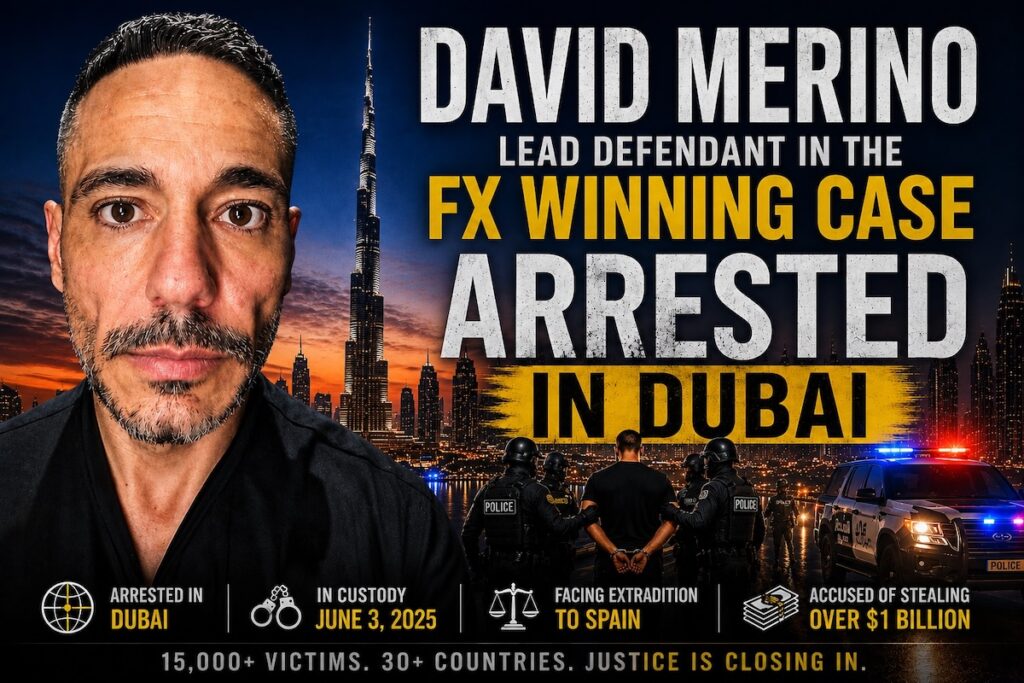
I spent a significant amount of time in Dubai during 2025 and 2026, working with legal counsel, investigators, and others involved in the matter. Much of what happened during that phase of the investigation is something I will discuss carefully, and only to the extent it is appropriate. There are still victims seeking recovery, still legal proceedings underway, and still details that should not be disclosed publicly. But what I can say is that Dubai became a critical chapter in this investigation, and the work done there helped move the case from theory to action.
This is also where I think BlockDivers is different from many firms in the cryptocurrency investigation space. There are a lot of companies that can trace cryptocurrency and produce forensic blockchain reports. Some of them are very good at it. But our view has always been that the report is not the finish line. In complex fraud cases, the report is often just the starting point. The real question is whether the intelligence can be used to support legal action, engage law enforcement, identify assets, and create pressure in the right jurisdictions.
That is the work we have been doing quietly for the past year and a half.
The arrest of David Merino in Dubai is an important milestone, but it is not the end of the story. For victims, it is a sign that accountability may finally be moving closer. For me, it is a reminder that persistence matters, especially in cases where the people responsible believe that borders, shell companies, and cryptocurrency can protect them indefinitely.
This article is the first in a three-part series about the FX Winning investigation and BlockDivers’ role in helping move the case forward. I am going to share what I can, while continuing to protect client information, investigative methods, and details that remain sensitive. Part One is about the chase: how a blockchain tracing assignment became an international investigation. In Part Two, I will talk more about Dubai, how the investigation developed on the ground, and why that phase became so important.
There is much more to this story, and for the first time, I can finally begin telling it.