Why learning prompts may be the most valuable AI skill you develop over the next decade.
When most people first start using ChatGPT or other AI tools, they treat them like a search engine.
They type:
“Tell me about investing.”
Or:
“Help me write a business plan.”
And while the AI often provides a decent answer, the results can feel generic, incomplete, or underwhelming.
What many people don’t realize is that the quality of the output is often determined by the quality of the instructions you provide.
This is where prompts come in.
What Is a Prompt?
A prompt is simply the instruction you give an AI system.
But not all prompts are created equal.
A basic prompt asks a question.
An advanced prompt provides:
- A role
- Context
- Objectives
- Constraints
- Desired output format
Think of it this way:
If you walked into a room filled with experts and simply said, “Tell me about business,” you would get random answers.
But if you said:
“Act as a Fortune 500 CEO. Analyze my business model, identify weaknesses, and provide a 90-day improvement plan.”
The quality of the response would be dramatically different.
AI works much the same way.
The Difference Between a Beginner and a Power User
A beginner might ask:
“How do I start a business?”
A power user might ask:
“Act as a startup advisor who has helped launch 100 successful companies. Walk me through starting a business from idea validation to first customer acquisition. Include common mistakes, budget considerations, and a 90-day action plan.”
Both users are asking about the same topic.
One receives information.
The other receives a framework for execution.
The Rise of the “God Prompt”
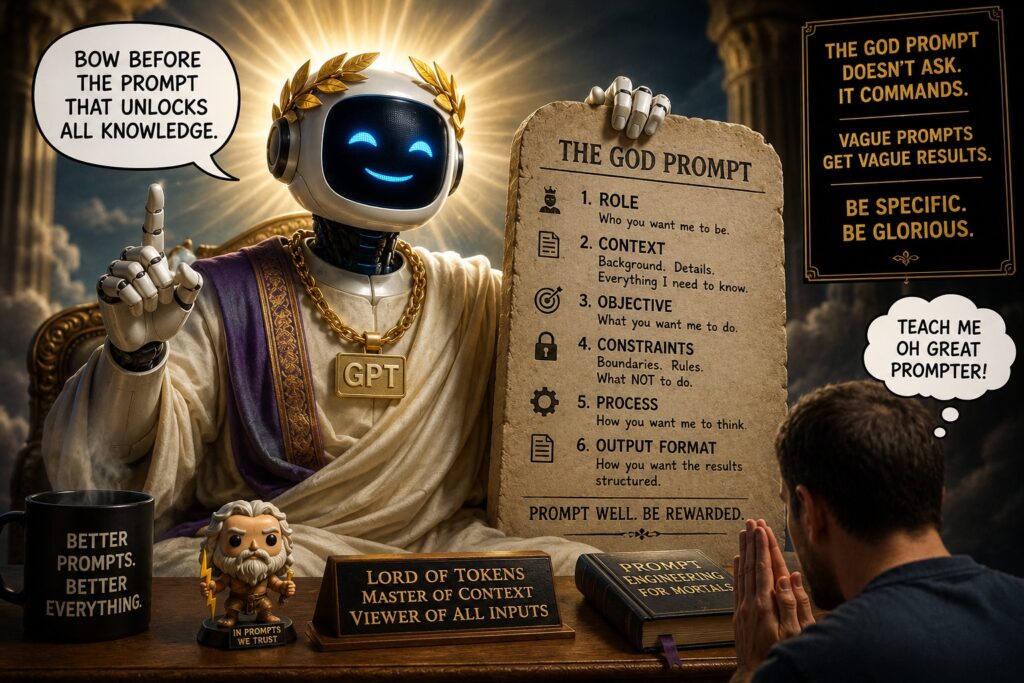
Recently, the AI community has started using the term “God Prompt.”
While the name sounds dramatic, the idea is simple.
A God Prompt is a highly structured instruction set that tells the AI:
- What role to assume
- How to think
- What process to follow
- What output to deliver
Instead of asking for an answer, you’re asking the AI to perform a methodology.
For example:
Act as a world-class researcher. Analyze this topic from multiple perspectives, identify assumptions, challenge conclusions, highlight risks, and provide evidence-based recommendations.
That single instruction can dramatically improve the depth and quality of the response.
Five Prompt Frameworks Everyone Should Know
1. The Research Prompt
Use this when you want deep analysis.
Ask the AI to:
- Examine multiple perspectives
- Challenge assumptions
- Identify risks
- Distinguish facts from speculation
- Provide recommendations
This is useful for investments, legal issues, business opportunities, and major decisions.
2. The Consultant Prompt
Use this when facing a business challenge.
Ask the AI to act as a management consultant and provide:
- Key issues
- Root causes
- Strategic options
- Pros and cons
- Recommended actions
This often produces far better results than simply asking for advice.
3. The Red Team Prompt
This is one of the most valuable prompts you can use.
Instead of asking the AI why your idea is good, ask it why your idea will fail.
Instruct it to:
- Find weaknesses
- Identify blind spots
- Challenge assumptions
- Expose hidden risks
Many bad decisions survive because nobody actively looks for flaws.
4. The Decision Prompt
When facing a difficult choice, ask the AI to evaluate:
- Financial impact
- Time commitment
- Risk
- Opportunity cost
- Long-term consequences
This creates a much more structured decision-making process.
5. The Learning Prompt
Ask the AI to teach a topic at multiple levels:
- Beginner
- Intermediate
- Advanced
- Expert
This allows you to build understanding progressively rather than becoming overwhelmed by complexity.
The Most Powerful Prompt of All
Ironically, the most useful prompt may be asking AI to create prompts for you.
Try this:
I want to achieve the following goal: [Goal]. Design the optimal prompt that would allow ChatGPT to help me achieve this outcome. Include the role, context, objectives, constraints, process, and output format.
This turns AI into a prompt engineer.
Instead of guessing how to ask the question, you let the AI help you design the question.
The Future Belongs to People Who Give Better Instructions
For decades, the most valuable skill was knowing where to find information.
Today, information is everywhere.
The emerging skill is knowing how to direct intelligence.
Whether you’re using AI for business, investing, writing, research, education, or personal development, your results will often be proportional to the quality of your instructions.
In other words:
The people who learn how to communicate effectively with AI won’t necessarily have more intelligence.
They’ll have more leverage.
And in the age of artificial intelligence, leverage may become one of the most valuable assets a person can possess.
The question isn’t whether AI will become more powerful.
It will.
The real question is whether you’ll learn how to use that power effectively.
Learning prompts is one of the best places to start.